


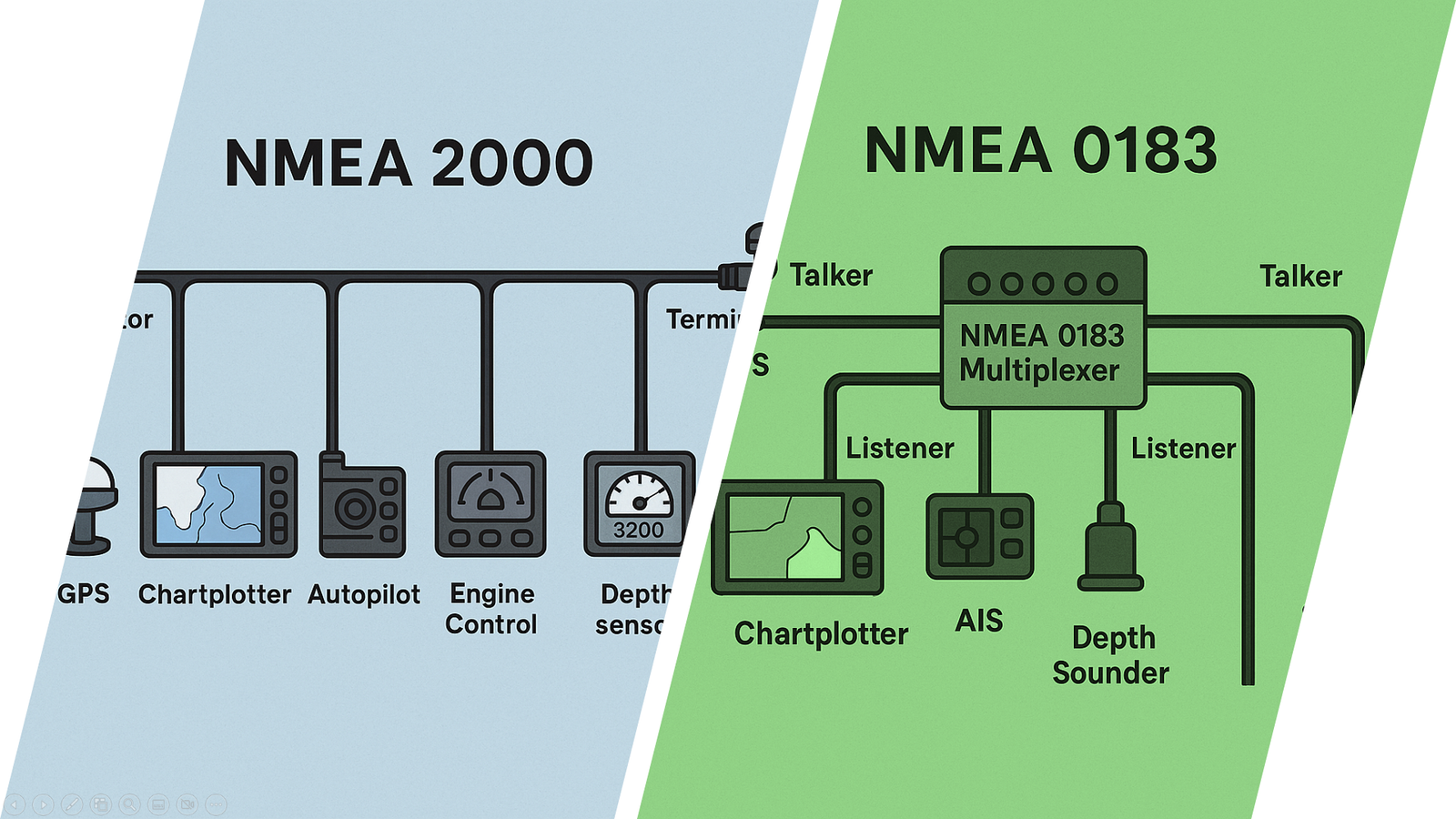
Anyone working with navigation electronics or interested in marine technology will often come across two terms: NMEA 0183 and NMEA 2000. Both are marine electronics data communication protocols, but they differ significantly both technically and in their intended use. In this blog we go through the most important differences and help you understand them.
Technical basis
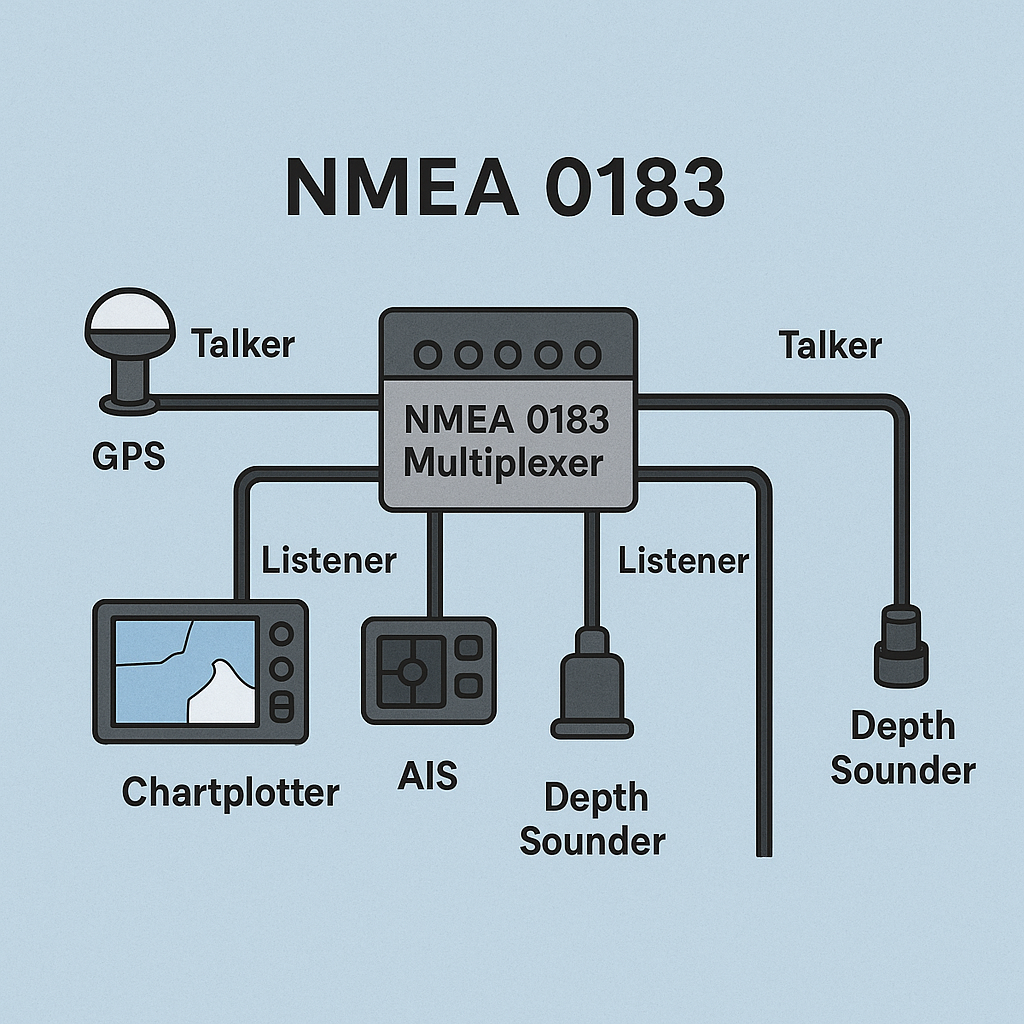
NMEA 0183 was originally developed back in the 1980s and is based on a serial port, more precisely on data transfer according to the RS-422 standard. This means that data transfer is essentially one-way – one device (for example a GPS) acts as the ”talker” and the others (for example a chartplotter) are ”listeners”. The typical data rate is 4,800 bits per second (bps), which is quite slow for today's needs. Messages are human-readable ASCII text, which makes troubleshooting easier but data transfer less efficient.
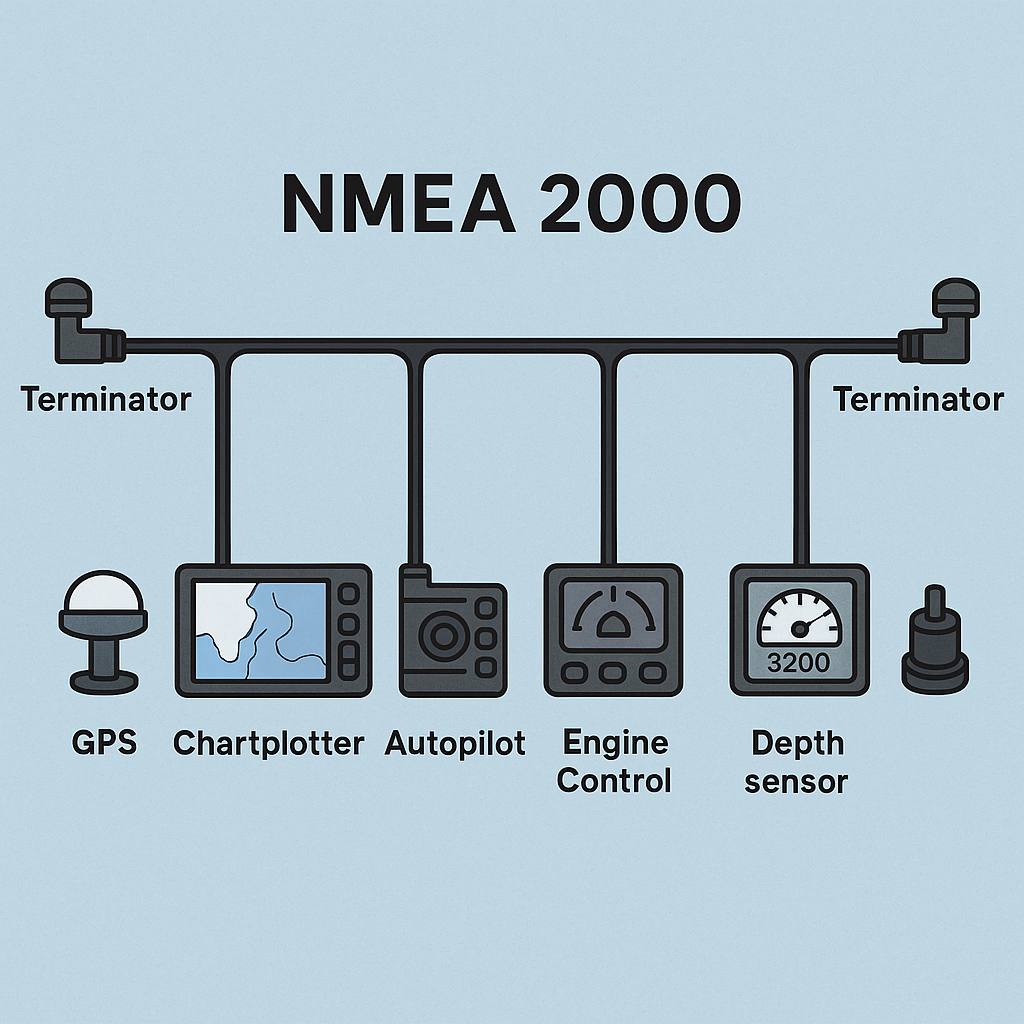
NMEA 2000 on the other hand is based on the CAN bus (Controller Area Network), which is widely used in automotive electronics, for example. The data rate is 250,000 bits per second, allowing much larger amounts of data to be carried. Messages are binary, which makes them compact and fast to process, but also hard to read without special tools.
Structurally, NMEA 2000 is a network: all devices connect to the same backbone cable via T-connectors. This allows several devices to both send and receive data at the same time – without separate splitters or converters. NMEA 2000 networks also use standardised Micro-C connectors, which makes compatibility and installation easier.
Unlike NMEA 0183, where every connection needs its own cabling, NMEA 2000 allows centralised and clearer wiring where all traffic goes through a shared bus. This makes the system not only more efficient but also much easier to expand.
Compatibility and usability
- NMEA 0183 is simple and easy to implement, but it supports only one ”talker” at a time. If you want to connect several devices, converters and separate splitters are often needed.
- NMEA 2000 was designed from the start for multi-device traffic: several devices can send and receive data simultaneously on the same network.
Applications
- NMEA 0183: Still in use, especially in older devices and simple systems. For example, an AIS, GPS or fishfinder can send data one-way to a chartplotter.
- NMEA 2000: The backbone of today's complex networked systems. Supports smart sensors, engine control, fuel systems, autopilots and other systems on the same network.
Installation and expandability
- NMEA 0183 -based systems can quickly end up with complicated cabling as devices are added.
- NMEA 2000 uses a ”plug and play” principle, where devices are connected to the backbone with T-connectors. Expanding the network is much easier.
Summary
- NMEA 0183, if:
- You have an older system or only individual devices.
- Your budget is limited.
- You only need one-way data transfer.
- NMEA 2000, if:
- You are building a new system or want a modern system that is easy to expand.
- You want several devices to communicate with each other seamlessly.
- You need fast and reliable data transfer.
Finally
Although NMEA 0183 is still usable in many situations, the flexibility, speed and easy expandability of NMEA 2000 make it the clear winner for new boat installations. Before upgrading a system or installing a new one, however, it is important to check compatibility with your existing devices – and use suitable converters where needed.
Leave a Reply